Benefits
SynoCell Benefits Ranked: Knee Comfort Comes First
The most likely SynoCell benefit is a small improvement in knee comfort and function.
That rests on ASU trials at 300 mg a day, and SynoCell lists 310 mg. Boswellia may also ease osteoarthritis pain.
Before you start, check who SynoCell suits.
Written by the SynoCell editorial teamUpdated
The short version
What are the real benefits of SynoCell?
The realistic benefit is modest: a possible small gain in joint comfort and function, mostly for the knee. That rests on research into single ingredients, not on a trial of SynoCell.
The brand sells SynoCell for joint comfort and mobility. Its slogan is "Move with freedom and ease." Those are structure and function claims, the kind supplements may make without FDA review (FDA S/F claims).
Two of the five ingredients carry most of the weight. ASU has the best data. Boswellia has promising but weaker data. The rest either help absorption or lack verified joint evidence.
Evidence strength
How strong is the evidence for each SynoCell benefit?
Ranked from the strongest support to the weakest.
| Possible benefit | Ingredient | Evidence strength | Key source |
|---|---|---|---|
| Less knee pain, better function | ASU 310 mg | Small to moderate; knee only; industry-funded trials | 2008 review of 4 trials (ASU meta-analysis (DARE)) |
| Less use of pain pills | ASU | Reported in one 2008 review | Arthritis Foundation (AF supplement guide) |
| Less osteoarthritis pain | Boswellia 200 mg | Promising; larger studies needed | NCCIH (NCCIH Boswellia) |
| Better absorption | Black pepper extract 5 mg | Shown for some nutrients in humans | 2020 review (BioPerine review) |
| Joint comfort | Quercetin 310 mg | Lab data only; not shown to treat any disease | MSKCC (MSKCC Quercetin) |
| Joint comfort | Hyaluronic acid 180 mg | Uncertain for capsules; not verified | ACR guideline covers injections only (ACR/AF 2019 guideline) |
A clear pattern shows up. The ingredients with the most research are the ones SynoCell doses closest to the studied amounts.
Benefit by benefit
What did studies of SynoCell's ingredients actually find?
Knee comfort
Four ASU trials with 664 people found modest gains in pain and function over 3 to 12 months. The knee improved; the hip result was not significant (ASU meta-analysis (DARE)).
Daily function
In the same review, for about every 6 people who took ASU, one more improved than would have on a dummy pill.
Osteoarthritis pain
Boswellia may reduce pain, but data conflict and trial quality is low (MSKCC Boswellia). Many trials used branded extracts rich in AKBA.
Absorption
BioPerine at 5 mg about doubled beta-carotene levels in people. It adds no joint effect by itself (BioPerine review).
Quercetin
Claims about inflammation come from lab work. No verified human joint dose exists.
Oral hyaluronic acid
Results from joint injections do not apply to capsules. See hyaluronic acid.
NCCIH sums up ASU and boswellia this way: slight improvements that patients may not find meaningful (NCCIH OA).
Brand claims
What do the claims on the SynoCell bottle mean?
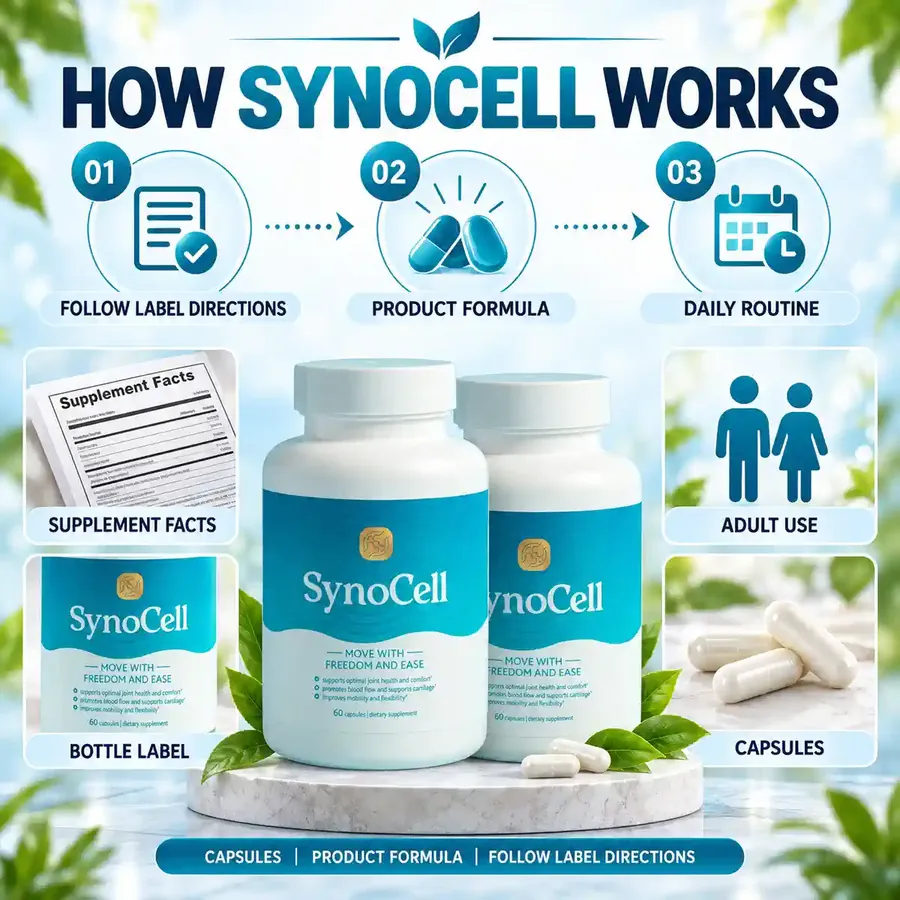
The brand's graphics show three bullet claims on the bottle. Each is the brand's own statement, not a proven fact.
| The brand claims | What we found |
|---|---|
| "Supports optimal joint health and comfort" | Small benefits for knee comfort from ASU; nothing on SynoCell itself |
| "Promotes blood flow and supports cartilage" | No verified human evidence in our sources for this formula |
| "Improves mobility and flexibility" | ASU trials found modest gains in function, mainly the knee |
Beyond the bottle, the brand's marketing goes further than its own disclaimer allows. We do not repeat its claims about cartilage, discs or inflammation, because supplements may not make disease claims (FDA S/F claims).
Limits
What can SynoCell not do for your joints?
SynoCell cannot reverse joint damage or replace medical care. It is a dietary supplement, and its label says it is not intended to diagnose, treat, cure or prevent any disease.
- No study shows it can rebuild cartilage or regrow tissue.
- It is not a treatment for osteoarthritis, rheumatoid arthritis or any other disease.
- It does not replace medicines your doctor prescribed.
- It cannot make up for inactivity or extra body weight.
Be wary of any joint product that promises fast or guaranteed change. FDA lists quick fixes and "one product does it all" claims as health-fraud warning signs (FDA 6 tip-offs).
In context
How do SynoCell's benefits compare with exercise and weight loss?
Exercise and weight loss have far stronger evidence than any joint supplement. The 2019 osteoarthritis guideline gives them its strongest recommendation (AF guideline summary).
| Option | Guideline view | Notes |
|---|---|---|
| Exercise and tai chi | Strongly recommended | Reduces pain and stiffness (NIAMS OA) |
| Weight loss | Strongly recommended | Each pound lost cuts knee load 3 to 6 times (StatPearls OA) |
| Canes and braces | Strongly recommended | For knee and hip (AF guideline summary) |
| Glucosamine | Strongly against | The GAIT trial of about 1,600 people found no clear overall benefit (AF glucosamine) |
| ASU, boswellia | Not addressed | Small, mixed research (ACR/AF 2019 guideline) |
The best-known joint supplement, glucosamine, fell short in large trials. That history is worth keeping in mind for any newer formula.
Who may notice
Who is most likely to notice a benefit from SynoCell?
People with mild knee stiffness who also stay active are the best match for the research. The ASU trials studied adults with knee or hip osteoarthritis, and the knee results were the clearer ones (ASU meta-analysis (DARE)).
Results vary. Some people notice nothing, which is common with joint supplements. The who it's for page covers who should ask a doctor first.
A hot, red or very swollen joint, fever, a joint that locks or gives way, or pain that wakes you at night needs a doctor's visit first.
By the numbers
What numbers sum up SynoCell's benefits?
FAQ
SynoCell benefits: FAQ
Does SynoCell really work for joint pain?
SynoCell may give a small benefit for knee comfort, based on trials of its main ingredient, ASU, at 300 mg a day (ASU meta-analysis (DARE)). No trial has tested SynoCell itself. Many people notice little change, and it is not a treatment for arthritis.
What are the benefits of SynoCell for knees?
The knee is where the evidence is clearest. A 2008 review of four ASU trials found small to moderate gains in knee pain and function over 3 to 12 months (ASU meta-analysis (DARE)). SynoCell lists 310 mg of ASU, close to the studied 300 mg.
Does SynoCell help hip pain?
The evidence is weaker for the hip. In the same 2008 ASU review, the hip result was not statistically significant (ASU meta-analysis (DARE)). Hip pain that limits walking deserves a doctor's exam, since exercise, weight control and other care have stronger support.
Does SynoCell support cartilage, as the bottle says?
That is the brand's claim, not a proven fact. Our sources show no verified human evidence that SynoCell or its formula supports cartilage. Supplements may not claim to treat disease, and osteoarthritis cannot be reversed by any capsule.
Is SynoCell better than glucosamine?
No head-to-head study exists. Glucosamine has more research but disappointing results: the ACR strongly advises against it (ACR/AF 2019 guideline). ASU, SynoCell's lead ingredient, has small positive trials, but that does not prove SynoCell works better.
Can SynoCell replace my arthritis medicine?
No. SynoCell is a dietary supplement, not a drug, and it is not meant to treat arthritis. Keep taking any prescribed medicine unless your doctor changes it. Some of its ingredients may also interact with medicines (MSKCC Quercetin).
How much benefit can I expect from SynoCell?
Expect a small benefit at best. NCCIH describes the improvements from ASU and boswellia as slight, and says patients may not find them meaningful (NCCIH OA). Track stairs, walks and stiffness so you can judge it fairly.
Who wrote this
Written and reviewed by
Plain-language pages built from the bottle label, the order page and linked public health sources such as NIH, FDA and CDC.
Last updated . See our editorial standards and how we check reviews. This website is run by a U.S. retail desk for SynoCell, not by the manufacturer. This site earns money when you buy through our order links.
Keep reading
More about SynoCell
How it works
What each of the five SynoCell ingredients was studied for, and where the research runs out.
Read more
Results timeline
How long SynoCell ingredient studies ran, what to track week by week, and how to judge it inside 90 days.
Read moreWho it's for
A quick fit check for SynoCell: who it may suit, who should talk to a doctor first, and why.
Read moreLicensed U.S. retail desk for SynoCell
Ready to try SynoCell?
Pick a pack. Two capsules a day; the 3- and 6-bottle packs cover the whole 90-day window.
- Secure brand checkout
- 90-day money-back window
- Free U.S. mainland shipping