Formula
SynoCell Ingredients List and Amounts Per Serving
SynoCell uses five ingredients, each with its own amount and no hidden blend.
One 2-capsule serving holds ASU 310 mg, quercetin 310 mg, boswellia extract 200 mg, hyaluronic acid 180 mg and black pepper extract (BioPerine) 5 mg, or 1,005 mg in all.
Written by the SynoCell editorial teamUpdated
The formula
What ingredients are in SynoCell?
SynoCell lists five ingredients, and the brand's product page prints an amount for every one. A serving is 2 capsules, and one bottle holds 30 servings.
| Ingredient | Per serving | Share of the 1,005 mg | Type |
|---|---|---|---|
| Avocado/soybean unsaponifiables (ASU) | 310 mg | About 31% | Plant oil extract |
| Quercetin | 310 mg | About 31% | Plant pigment |
| Boswellia serrata extract (65% boswellic acids) | 200 mg | About 20% | Tree resin extract |
| Hyaluronic acid | 180 mg | About 18% | Joint-fluid molecule |
| Black pepper extract (BioPerine) | 5 mg | Under 1% | Absorption helper |
The capsule shell, fillers and any other ingredients are not listed on the brand's web pages. Read the label on the bottle you receive for those.
All 5
What does each SynoCell ingredient do, in label order?
Tap or hover a card to see the amount, the research dose and the main caution.
-
01
Avocado/soybean unsaponifiables (ASU)
Plant fractions of avocado and soybean oils · Plant oil extract
Studied for knee and hip osteoarthritis symptoms
Evidence: Small benefit, mainly kneePer serving310 mg, printed
Studied at300 mg a day in trials
Watch forMade from avocado and soybean: ask first if you have a soy or avocado allergy.
Full profile -
02
Quercetin
Plant flavonoid · Plant pigment (flavonoid)
Plant compound studied in the lab for inflammation
Evidence: Not shown to treat any diseasePer serving310 mg, printed
Studied atNo verified joint research dose
Watch forMay affect drug-processing enzymes; a case report showed warfarin's effect rising; not with losartan.
Full profile -
03
Boswellia serrata
Boswellia serrata · Tree resin extract
Indian frankincense resin studied for osteoarthritis pain
Evidence: Promising but low qualityPer serving200 mg, printed (65% boswellic acids)
Studied atUp to 1,000 mg a day of extract for up to 6 months
Watch forStomach upset; possible bleeding risk with blood thinners; ask first with asthma, RA or lupus.
Full profile -
04
Hyaluronic acid
Sodium hyaluronate family · Joint-fluid molecule
A natural part of joint fluid, sold as capsules
Evidence: Uncertain (oral form)Per serving180 mg, printed
Studied atOral research not verified in our sources; guidelines discuss injections only
Watch forInjection results do not apply to capsules; ACR advises against hip injections.
Full profile -
05
Black pepper extract (BioPerine)
Piper nigrum (piperine) · Absorption enhancer
Added to raise absorption of other ingredients
Evidence: Raises absorptionPer serving5 mg, printed
Studied at5 mg raised nutrient absorption in human studies
Watch forMay also raise blood levels of some medicines processed by the liver.
Full profile
Dose check
How do SynoCell's amounts compare with research doses?
Two of the five match the doses used in studies: ASU and black pepper extract. Boswellia sits inside the studied range but near its low end. Quercetin and oral hyaluronic acid have no verified joint dose to compare against.
| Ingredient | On the label | Per serving | Amount used in research | Evidence |
|---|---|---|---|---|
| Avocado/Soybean Unsaponifiables (ASU) | Printed | 310 mg, printed | 300 mg a day in trials (ASU meta-analysis (DARE)) (AF 12 supplements) (AF supplement guide) (NCCIH OA) | Small benefit, mainly knee |
| Quercetin | Printed | 310 mg, printed | No verified joint research dose (MSKCC Quercetin) | Not shown to treat any disease |
| Boswellia extract (Boswellia serrata) (gum resin) (std. to 65% boswellic acid) | Printed | 200 mg, printed (65% boswellic acids) | Up to 1,000 mg a day of extract for up to 6 months (NCCIH Boswellia) (MSKCC Boswellia) (AF 12 supplements) (AF supplement guide) | Promising but low quality |
| Hyaluronic acid | Printed | 180 mg, printed | Oral research not verified in our sources; guidelines discuss injections only (ACR/AF 2019 guideline) | Uncertain (oral form) |
| Black Pepper (fruit) Extract (BioPerine) | Printed | 5 mg, printed | 5 mg raised nutrient absorption in human studies (BioPerine review) | Raises absorption |
A matching dose is a good start, not a promise. The FTC says research must match the product's dose and formula to back a claim (FTC health products). No trial has tested SynoCell itself, so each study speaks only for the ingredient it tested.
At a glance
SynoCell's formula by the numbers
Evidence
Which SynoCell ingredients have the strongest research?
ASU has the best support of the five, and even that is modest. Boswellia comes second. The other three rest on lab work, injection data or absorption studies.
ASU: small benefit, mainly for the knee
A 2008 meta-analysis pooled four trials with 664 people taking 300 mg a day for 3 to 12 months. It found a small-to-moderate gain in pain and function, mostly in the knee (ASU meta-analysis (DARE)). All four trials were funded by industry.
Boswellia: promising, low quality
NCCIH says boswellia may ease osteoarthritis pain, but larger and better studies are needed (NCCIH Boswellia). Several studied extracts were branded and enriched in one acid, AKBA (AF supplement guide). SynoCell lists total boswellic acids instead, so the match is not exact.
Quercetin, hyaluronic acid and black pepper
Memorial Sloan Kettering says quercetin has not been shown to treat any disease (MSKCC Quercetin). Joint guidelines discuss hyaluronic acid only as a knee or hip injection (ACR/AF 2019 guideline), which says nothing about capsules. Black pepper extract is there to raise absorption, not to act on joints (BioPerine review).
Label honesty
Why does it matter that SynoCell has no proprietary blend?
It lets you and your pharmacist check every dose. Many joint products hide amounts inside a "blend" that shows only a total weight. SynoCell prints all five numbers. That counts in its favor.
A printed amount is the brand's claim. NCCIH warns that supplement labels do not always match what is inside (NCCIH supplements wisely). No lab report for SynoCell has been published. Our batch check guide explains what to look for on your bottle.
Brand images
What do the SynoCell ingredient pictures show?
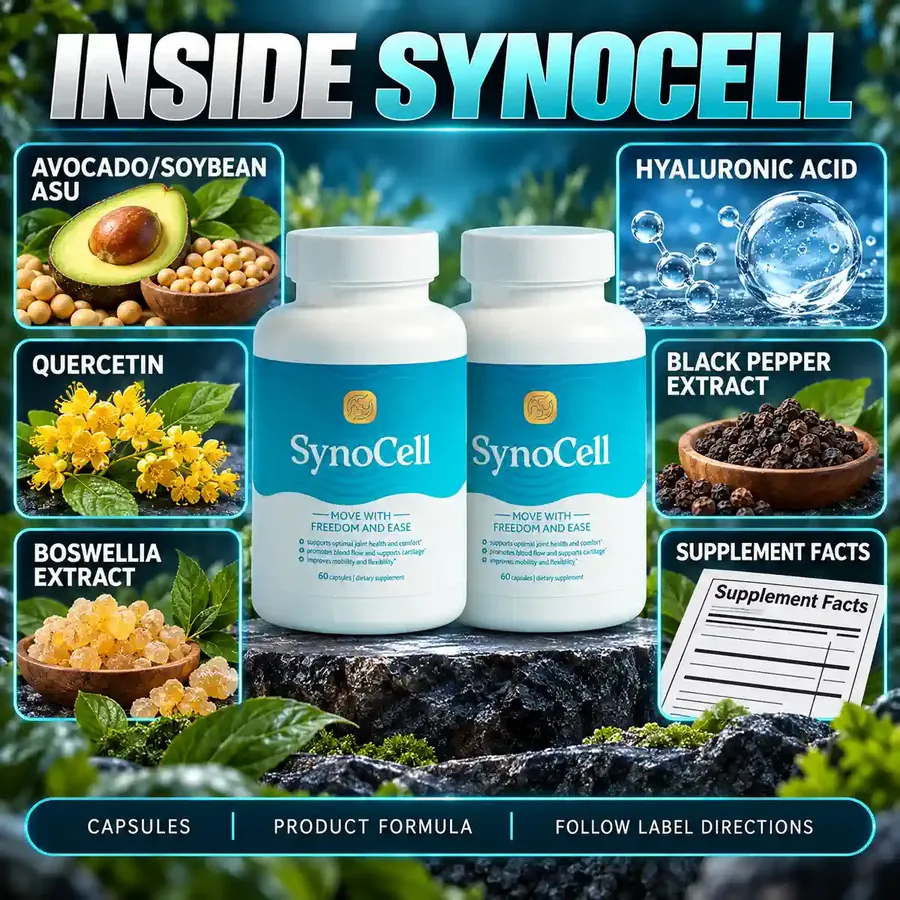
The brand's "Inside SynoCell" graphic pairs each ingredient with a picture. Avocado and soybeans stand for ASU, yellow flowers for quercetin and resin drops for boswellia. Water molecules stand for hyaluronic acid, and peppercorns for the black pepper extract.
The graphic shows no amounts. The numbers on this site come from the brand's product page instead.
Before you start
Which SynoCell ingredients can interact with medicines?
Three of the five carry medicine cautions: quercetin, boswellia and black pepper extract. The fourth, ASU, is made from avocado and soybean, so allergies matter.
Quercetin raised warfarin's effect in a case report and is advised against with losartan (MSKCC Quercetin). Boswellia may add bleeding risk (MSKCC Boswellia). Piperine may raise blood levels of some medicines (BioPerine review). Show the label to your pharmacist before the first dose.
A hot, red or very swollen joint, fever, or pain after a fall needs a doctor, not a supplement. The side effects guide lists every caution in one place.
Fair verdict
Is the SynoCell formula good?
It is clearer than most, and ASU is dosed like the trials. The rest of the evidence is thin. The full formula has never been tested.
Points in its favor
- Every amount printed, no proprietary blend
- ASU at 310 mg, close to the 300 mg studied
- Black pepper extract at the 5 mg used in absorption studies
- Boswellia inside the studied range
- Just 2 capsules a day
Weak spots
- No trial of SynoCell itself
- No verified joint evidence for quercetin or oral hyaluronic acid
- Boswellia not stated as AKBA, and lower than many trials
- Several medicine cautions stack up
- Other ingredients not listed on the brand's web pages
Exercise and weight management remain the first steps in joint guidelines (AF guideline summary). See how SynoCell is meant to work for the brand's own framing.
FAQ
SynoCell ingredients FAQ
What are the main ingredients in SynoCell?
SynoCell's five ingredients are ASU 310 mg, quercetin 310 mg, boswellia extract 200 mg, hyaluronic acid 180 mg and black pepper extract (BioPerine) 5 mg per 2 capsules. The brand's product page prints each amount, for 1,005 mg per serving. Check the label on your bottle for the capsule shell and other ingredients.
Is the 310 mg ASU dose close to the research dose?
Yes, 310 mg of ASU is close to the 300 mg a day used in trials. A 2008 meta-analysis of four trials found a small benefit at that dose, mainly for knee pain and function (ASU meta-analysis (DARE)). Those trials used a specific ASU product, and SynoCell's source is not published.
Does SynoCell have a proprietary blend?
No, SynoCell has no proprietary blend. The brand's product page prints a separate amount for each of the five ingredients, which add up to 1,005 mg per serving. That lets you and your pharmacist check every dose, which many joint products with hidden blends do not allow.
Is the hyaluronic acid in SynoCell the same as a knee injection?
No, SynoCell's 180 mg of hyaluronic acid is swallowed in a capsule, not injected into a joint. Guideline findings on injections do not apply to capsules. The ACR guideline advises against hyaluronic acid injections in the hip and conditionally against them in the knee (ACR/AF 2019 guideline).
Why is black pepper extract in SynoCell?
Black pepper extract (BioPerine) is in SynoCell to raise absorption of the other ingredients. At 5 mg, it roughly doubled beta-carotene levels in human studies (BioPerine review). The same effect may raise blood levels of some medicines, so ask a pharmacist if you take prescriptions.
Is SynoCell safe if I am allergic to soy?
Ask your doctor first if you have a soy or avocado allergy, because ASU is made from avocado and soybean oils. The Arthritis Foundation notes ASU can trigger allergic reactions (AF 12 supplements). The brand's web pages print no allergen statement, so check your bottle's label.
Who wrote this
Written and reviewed by
Plain-language pages built from the bottle label, the order page and linked public health sources such as NIH, FDA and CDC.
Last updated . See our editorial standards and how we check reviews. This website is run by a U.S. retail desk for SynoCell, not by the manufacturer. This site earns money when you buy through our order links.
Keep reading
More about SynoCell
Supplement Facts
The SynoCell Supplement Facts explained line by line, plus the label details the brand's web pages leave out.
Read more
Side effects
SynoCell side effects ingredient by ingredient, the medicine interactions that matter most, and when to stop.
Read more
How it works
What each of the five SynoCell ingredients was studied for, and where the research runs out.
Read moreLicensed U.S. retail desk for SynoCell
Ready to try SynoCell?
Pick a pack. Two capsules a day; the 3- and 6-bottle packs cover the whole 90-day window.
- Secure brand checkout
- 90-day money-back window
- Free U.S. mainland shipping