Ingredient profile
Boswellia in SynoCell: The 200 mg Dose, the Research and the Cautions
SynoCell lists 200 mg of Boswellia serrata extract per 2-capsule serving, standardized to 65% boswellic acids. That sits inside the range used in trials, which went up to 1,000 mg a day for up to 6 months (NCCIH Boswellia). NCCIH says boswellia may reduce osteoarthritis pain, but larger, better studies are needed. It may raise bleeding risk with blood thinners (MSKCC Boswellia).
Written by the SynoCell editorial teamUpdated
The basics
What is boswellia, and why is it in SynoCell?
Boswellia serrata is a tree native to India. Indian frankincense is another name for its gum resin.
Its active compounds are called boswellic acids. One of them, AKBA, gets the most attention in research.
SynoCell lists boswellia third on the Supplement Facts panel, after ASU and quercetin. The brand does not explain on its web pages why it chose this extract. It is there as one of five ingredients sold for joint comfort and mobility.
| Label name | Boswellia extract (Boswellia serrata) (gum resin) (std. to 65% boswellic acid) |
|---|---|
| What it is | Boswellia serrata · Tree resin extract |
| Position on the label | Printed with its own amount |
| Amount per serving (2 capsules) | 200 mg, printed (65% boswellic acids) |
| Amount used in research | Up to 1,000 mg a day of extract for up to 6 months |
| Strength of evidence | Promising but low quality |
| Why it is used | Indian frankincense resin studied for osteoarthritis pain |
| Main caution | Stomach upset; possible bleeding risk with blood thinners; ask first with asthma, RA or lupus. |
On the label
How much boswellia is in each SynoCell serving?
The brand's product page lists 200 mg of boswellia extract per 2-capsule serving. The extract is standardized to 65% boswellic acid. Simple math puts that at about 130 mg of total boswellic acids a day.
That number is printed, not guessed. SynoCell has no proprietary blend, so every ingredient has its own amount. That is a real plus for anyone who wants to compare doses.
| Label name | Boswellia extract (Boswellia serrata) (gum resin) |
|---|---|
| Amount per serving | 200 mg (2 capsules) |
| Standardization | 65% boswellic acid |
| Total boswellic acids (math) | About 130 mg |
| AKBA content | Not published |
| Branded extract name | Not published |
| Daily Value | Not established (**) (FDA Labeling Ch IV) |
Evidence
What does research say about boswellia for joint pain?
The research is promising but not strong. NCCIH, part of the National Institutes of Health, says several studies suggest boswellia by mouth may reduce osteoarthritis pain. It adds that larger, higher-quality studies are needed (NCCIH Boswellia).
Memorial Sloan Kettering Cancer Center (MSKCC) calls the data conflicting (MSKCC Boswellia). The Arthritis Foundation rates the evidence quality as weak (AF 12 supplements). A 2014 review cited by NCCIH found boswellia and ASU gave slight improvements in pain and function that patients may not find meaningful (NCCIH OA).
What the better studies used
The Arthritis Foundation describes branded extracts rich in AKBA, at about 100 mg a day (AF supplement guide). It reports that a 2014 Cochrane review found pain scores about 20 points lower and function about 8 points better, on 100-point scales, at 3 months. Those results came from specific named extracts, not from boswellia in general.
No trial has tested SynoCell itself. The FTC says health claims need research that matches the product's dose and formula (FTC health products). So trial results on other extracts can only hint at what SynoCell's boswellia might do.
Side by side
How does SynoCell's 200 mg compare with the doses studied?
It sits inside the studied range, but toward the low end. NCCIH notes trials of up to 1,000 mg a day of extract for up to 6 months (NCCIH Boswellia). AKBA-rich extracts worked at about 100 mg a day (AF supplement guide).
| Product or study | Daily amount | What is standardized | Source |
|---|---|---|---|
| SynoCell (brand page) | 200 mg extract | 65% total boswellic acids | Brand product page |
| AKBA-rich branded extracts | About 100 mg | AKBA content | (AF supplement guide) |
| Trials summarized by NCCIH | Up to 1,000 mg extract, up to 6 months | Varies by trial | (NCCIH Boswellia) |
| Short trials summarized by NCCIH | Up to 2,400 mg, up to 1 month | Varies by trial | (NCCIH Boswellia) |
SynoCell lists total boswellic acids, not AKBA. Two extracts with the same 65% figure can hold very different amounts of AKBA. So SynoCell's 200 mg cannot be lined up directly with the AKBA trials.
Safety
What are the side effects of boswellia?
Boswellia is likely safe by mouth for most adults, NCCIH says (NCCIH Boswellia). The most common complaints involve the stomach.
- Nausea, stomach pain or diarrhea (AF 12 supplements)
- Headache, and less often fever or weakness (AF 12 supplements)
- Mild constipation, reported in people with irritable bowel syndrome (MSKCC Boswellia)
- Allergic skin reactions (MSKCC Boswellia)
MSKCC says boswellia has an antiplatelet effect, so it may raise bleeding risk with warfarin and other blood thinners (MSKCC Boswellia). If you take one, ask your doctor before starting SynoCell. Quercetin in the same formula has its own warfarin report.
Before you start
Who should check with a doctor before taking boswellia?
A few groups should talk to a doctor or pharmacist first. The cautions involve bleeding, the immune system and other medicines.
Blood thinner users
Warfarin and antiplatelet drugs may combine with boswellia's antiplatelet effect.
People with RA or lupus
The Arthritis Foundation urges caution in rheumatoid arthritis and lupus (AF supplement guide).
People with asthma
NCCIH suggests asking a provider first if you have asthma or take medicines (NCCIH Boswellia).
People on several medicines
The Arthritis Foundation says boswellia may add to side effects of some antidepressants, anti-anxiety drugs, ibuprofen and immune-suppressing drugs (AF supplement guide).
MSKCC adds a lab finding: boswellia affects drug-transport proteins in test tubes (MSKCC Boswellia). Nobody knows yet if that matters in people. Pregnant or nursing? There are no safety data for this formula, so ask first. The full SynoCell side effects page covers all five ingredients.
Our view
Is the boswellia in SynoCell worth having?
It is a reasonable choice with honest limits. The dose is printed and inside the studied range. But the evidence is weak, and the label does not state AKBA.
Pros
- 200 mg printed, with a stated 65% standardization
- Inside the range NCCIH describes for trials
- Likely safe by mouth for most adults
- Side effects are usually mild and stomach-related
Cons
- AKBA content not published
- Lower than many trials, which reached 1,000 mg
- Evidence rated weak and conflicting
- Possible bleeding risk with blood thinners
Exercise and weight management still do the most for sore knees and hips (AF guideline summary). A hot, red or very swollen joint needs a doctor, not a supplement. For the full picture of what is in each capsule, see the SynoCell Supplement Facts breakdown.
Keep exploring
Which SynoCell ingredients come before and after boswellia?
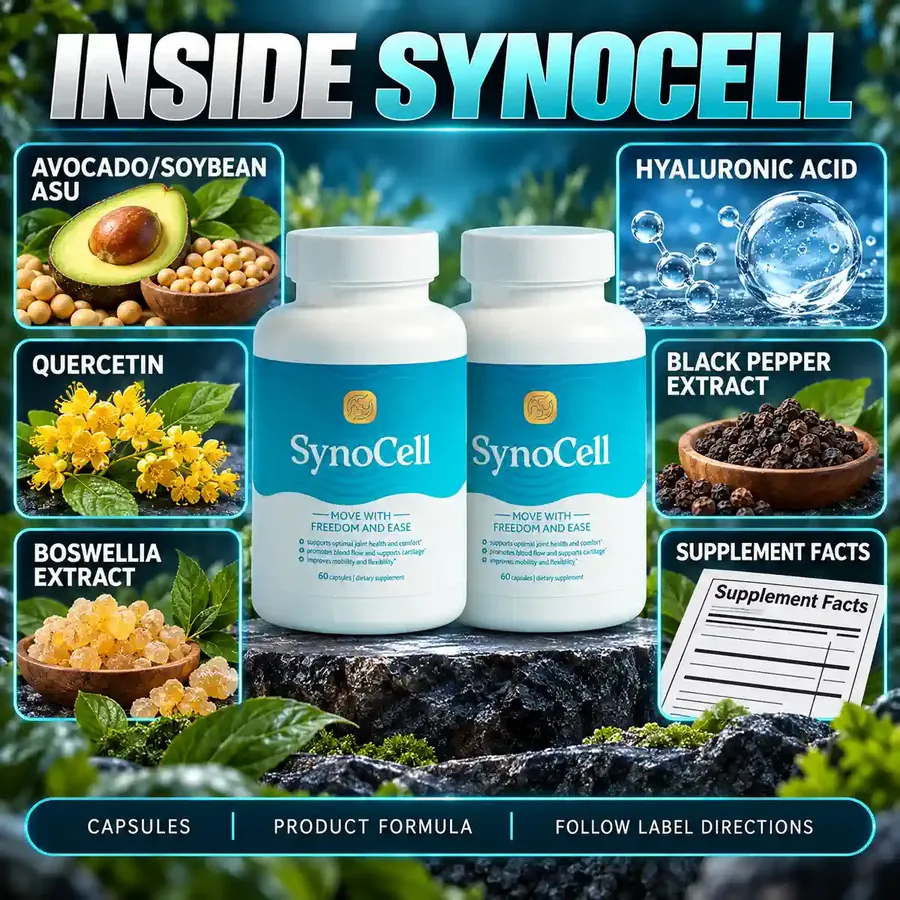
Quercetin comes just before boswellia on the panel, at 310 mg. Hyaluronic acid follows at 180 mg. Black pepper extract closes the list at 5 mg and may raise absorption of the others.
See how all five fit together in the SynoCell ingredient guide.
FAQ
Boswellia in SynoCell: common questions
How much boswellia is in SynoCell?
SynoCell lists 200 mg of Boswellia serrata extract per 2-capsule serving, per the brand's product page. The extract is standardized to 65% boswellic acid, or about 130 mg of total boswellic acids. AKBA content is not published. Check the label on your bottle.
Is 200 mg of boswellia enough to work?
It is inside the studied range but toward the low end. NCCIH says trials used up to 1,000 mg a day of extract for up to 6 months (NCCIH Boswellia). AKBA-rich extracts were studied at about 100 mg a day (AF supplement guide), but SynoCell does not state its AKBA level.
Does boswellia help knee osteoarthritis?
It may help a little. NCCIH says several studies suggest boswellia may reduce osteoarthritis pain, but larger and better studies are needed (NCCIH Boswellia). MSKCC calls the data conflicting (MSKCC Boswellia). No trial has tested boswellia inside SynoCell.
Can I take boswellia with warfarin?
Ask your doctor first. Memorial Sloan Kettering says boswellia has an antiplatelet effect and may raise bleeding risk with warfarin and other blood thinners (MSKCC Boswellia). SynoCell also contains quercetin, which has a warfarin case report of its own (MSKCC Quercetin).
What are the side effects of boswellia serrata?
The most common side effects of boswellia are nausea, stomach pain, diarrhea and headache, per the Arthritis Foundation (AF 12 supplements). MSKCC also lists allergic skin reactions (MSKCC Boswellia). Stop and call a doctor if you get a rash or unusual bruising.
What is AKBA in boswellia?
AKBA is one of the boswellic acids in boswellia resin. Branded extracts rich in AKBA were used in several joint trials at about 100 mg a day (AF supplement guide). SynoCell's label states 65% total boswellic acids and does not give an AKBA figure.
Is boswellia safe for people with rheumatoid arthritis?
Ask your rheumatologist first. The Arthritis Foundation advises caution with boswellia in rheumatoid arthritis and lupus (AF supplement guide). SynoCell is not a treatment for rheumatoid arthritis or any other disease.
Who wrote this
Written and reviewed by
Plain-language pages built from the bottle label, the order page and linked public health sources such as NIH, FDA and CDC.
Last updated . See our editorial standards and how we check reviews. This website is run by a U.S. retail desk for SynoCell, not by the manufacturer. This site earns money when you buy through our order links.
Keep reading
More about SynoCell
ASU (avocado/soybean)
SynoCell's ASU dose sits right at the 300 mg studied. What four trials found, and what they cannot tell you.
Read moreHyaluronic acid
SynoCell has 180 mg of hyaluronic acid in capsules. Why injection research does not carry over, and what stays unknown.
Read more
Side effects
SynoCell side effects ingredient by ingredient, the medicine interactions that matter most, and when to stop.
Read moreLicensed U.S. retail desk for SynoCell
Ready to try SynoCell?
Pick a pack. Two capsules a day; the 3- and 6-bottle packs cover the whole 90-day window.
- Secure brand checkout
- 90-day money-back window
- Free U.S. mainland shipping