How it works
How SynoCell Works: Inside the Joint Support Formula
SynoCell is a joint support supplement built on five printed ingredients in 2 capsules.
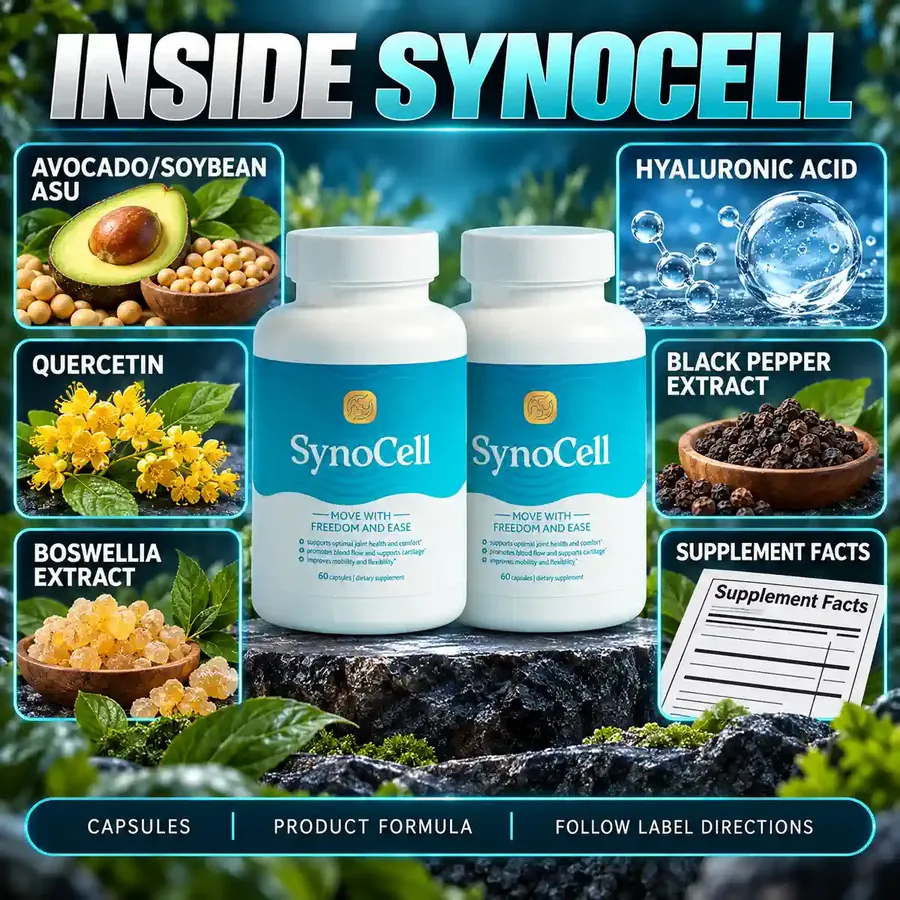
ASU 310 mg and boswellia 200 mg lead the formula, and both have research on osteoarthritis symptoms. Quercetin 310 mg, hyaluronic acid 180 mg and black pepper extract 5 mg complete it.
To compare costs, see SynoCell prices.
Written by the SynoCell editorial teamUpdated
The idea
What is SynoCell designed to do?
SynoCell is built to support everyday joint comfort and mobility, not to fix a disease. The bottle sums it up in the brand's words: "Move with freedom and ease."
It is a dietary supplement. Supplements may describe how an ingredient supports normal body function. They may not claim to treat a disease, and those structure and function claims are not reviewed by FDA before sale (FDA S/F claims).
The formula is short. Five ingredients add up to 1,005 mg per 2-capsule serving, and each one has its own printed amount. There is no proprietary blend hiding the doses, which makes SynoCell easier to judge than many joint products.
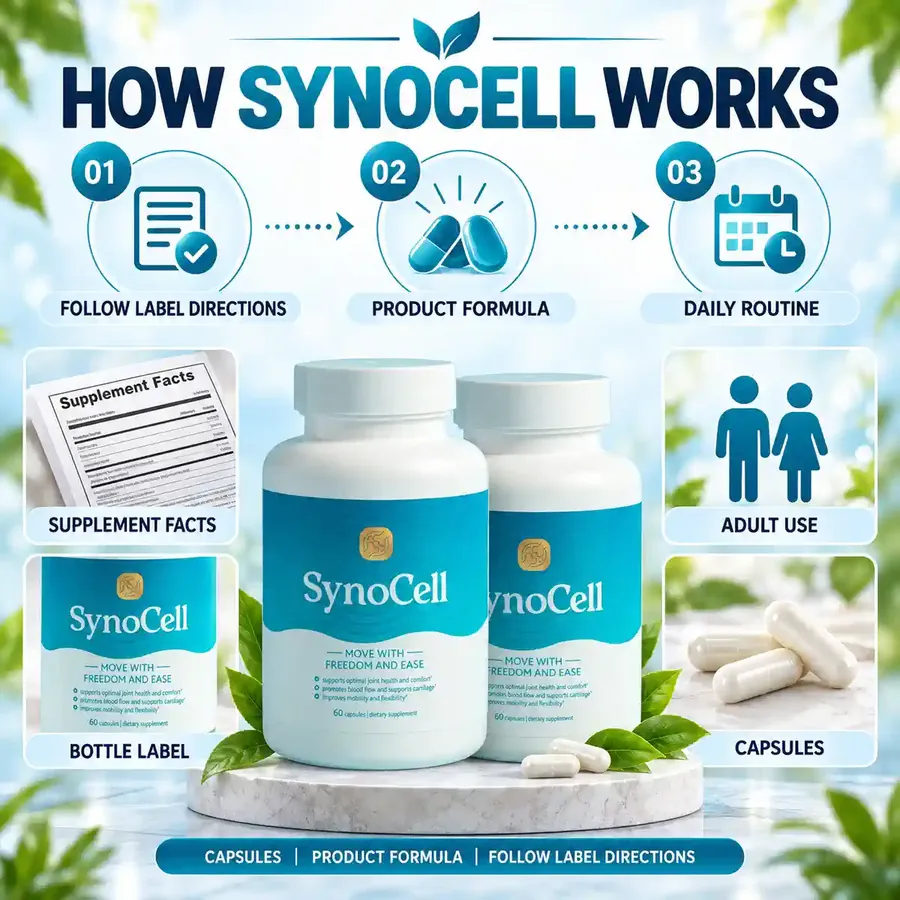
Four steps
How do you put SynoCell to work day to day?
Read the label, take two capsules, keep moving and judge it by day 90.
- 01
Read the label
Five ingredients, each with its own printed amount. Check them against your medicines and allergies.
- 02
Take two capsules
Two capsules a day, per the brand page. Follow the directions on your bottle.
- 03
Keep moving
Exercise and weight management do the heavy lifting for joints. A supplement sits on top of them.
- 04
Judge it by day 90
Track stairs, walks and stiffness. Ask for a refund inside 90 days if it is not for you.
Five ingredients
What was each SynoCell ingredient studied for?
Two ingredients have human research for osteoarthritis symptoms. The other three play a supporting role or have no verified joint data at all.
| Ingredient | Per serving | Studied for | What the research shows |
|---|---|---|---|
| ASU | 310 mg | Knee and hip osteoarthritis symptoms | Small to moderate gains in pain and function, mainly the knee (ASU meta-analysis (DARE)) |
| Quercetin | 310 mg | Lab studies on inflammation | Not shown to treat any disease; no verified joint dose (MSKCC Quercetin) |
| Boswellia | 200 mg | Osteoarthritis pain | May ease pain; larger, better studies are needed (NCCIH Boswellia) |
| Hyaluronic acid | 180 mg | A natural part of joint fluid | Capsule evidence uncertain; guidelines cover injections only (ACR/AF 2019 guideline) |
| Black pepper extract | 5 mg | Raising absorption | About doubled beta-carotene levels in human studies (BioPerine review) |
Every finding above comes from studies of one ingredient. None of them tested this mix of five together.
Dose check
How do SynoCell doses compare with the research?
Three ingredients have a known research dose. Here is how the label lines up.
ASU is the closest match. A 2008 review of four trials, 664 people in all, used 300 mg a day for 3 to 12 months (ASU meta-analysis (DARE)). SynoCell lists 310 mg. Those trials used one specific ASU product, though. The brand does not publish the source or the avocado to soybean ratio of its ASU, so results may not carry over (FTC health products).
Boswellia sits inside the studied range but toward the low end. NCCIH notes trials of up to 1,000 mg of extract a day for up to 6 months (NCCIH Boswellia). Some of the best-known trials used extracts rich in a compound called AKBA. SynoCell's label states 65% total boswellic acids instead, so it cannot be matched to those studies one for one.
The helper
Why does SynoCell include black pepper extract?
The 5 mg of black pepper extract is there to help the body absorb more of the other ingredients. That is the same amount used in human absorption studies of BioPerine (BioPerine review).
The same effect can reach your medicines. Piperine may slow liver enzymes that clear many drugs, which could raise their blood levels. Researchers say this "could enhance both therapeutic and adverse effects" (BioPerine review).
Black pepper extract, quercetin and boswellia each carry interaction cautions, including with blood thinners and losartan (MSKCC Quercetin) (MSKCC Boswellia). Show the label to your pharmacist before your first dose.
The full list sits on the side effects and interactions page.
Marketing
Does SynoCell work the way its ads describe?
Not as far as the evidence shows. The brand's marketing goes further than its own disclaimer allows, and we do not repeat its claims about cartilage, discs or inflammation.
Federal rules are clear on this point. Supplements may not make disease claims (FDA S/F claims). A product sold to treat a disease is legally a drug (FDA Q&A). The FTC adds that a disclaimer does not fix a misleading claim, and that research must match the product's own dose and formula (FTC health products).
"These statements have not been evaluated by the Food and Drug Administration. This product is not intended to diagnose, treat, cure, or prevent any disease."
The benefits page sorts each brand claim by the strength of the evidence behind it.
The bigger picture
Can SynoCell replace osteoarthritis care?
No. Osteoarthritis cannot be cured, but physical activity, a healthy weight and joint protection help manage it (CDC OA). Guidelines give their strongest backing to exercise, weight loss, self-management, tai chi, canes and braces (AF guideline summary).
The 2019 joint guideline from the American College of Rheumatology and the Arthritis Foundation does not address ASU, boswellia, quercetin or oral hyaluronic acid at all (ACR/AF 2019 guideline). NCCIH says ASU and boswellia give slight improvements that patients may not find meaningful (NCCIH OA).
A supplement can sit on top of those basics. It cannot stand in for them. A hot, red or very swollen joint, fever, a sudden injury, or pain that wakes you at night needs a doctor, not a capsule.
Realistic
What can you realistically expect from how SynoCell works?
- ASU at the 300 mg level used in knee trials
- Boswellia within the studied range, at its lower end
- Two ingredients with no verified joint evidence
- An absorption helper that may affect some medicines
- No trial of SynoCell itself, so no promised result
FAQ
How SynoCell works: FAQ
How does SynoCell work for joints?
SynoCell combines five ingredients meant to support joint comfort and mobility. ASU and boswellia have small, mixed research for osteoarthritis symptoms. Quercetin and oral hyaluronic acid lack verified joint evidence, and black pepper extract raises absorption. No study has tested SynoCell as a whole.
What is the main ingredient in SynoCell?
ASU and quercetin are tied as the largest ingredients, at 310 mg each per 2-capsule serving. ASU has the stronger case: a review of four trials at 300 mg a day found small to moderate benefits, mainly for the knee (ASU meta-analysis (DARE)).
Can SynoCell help worn cartilage grow back?
No evidence shows SynoCell can rebuild cartilage. None of its five ingredients has been shown to do that in people, and supplements may not claim to treat a disease (FDA S/F claims). Osteoarthritis is managed with exercise, weight control and medical care.
Is any SynoCell amount hidden in a blend?
No. The brand's product page lists all five ingredients with their own amounts, 1,005 mg in total per serving. That openness lets you compare each dose with research, which a hidden blend would not allow.
Is 310 mg of ASU in SynoCell enough to work?
It is close to the 300 mg a day used in trials, which found small benefits mainly for knee osteoarthritis (ASU meta-analysis (DARE)). The trials used a specific ASU product, and the brand does not publish where its ASU comes from, so results may differ.
Why is there black pepper in SynoCell?
SynoCell adds 5 mg of black pepper extract (BioPerine) to help absorb the other ingredients. That matches human absorption studies (BioPerine review). It may also raise blood levels of some medicines, so check with a pharmacist if you take any.
Has the FDA checked how SynoCell works?
No. FDA does not approve dietary supplements for safety or effectiveness before they are sold (FDA 101). SynoCell carries the standard statement that its claims were not evaluated by FDA and that it is not meant to diagnose or treat any disease.
Who wrote this
Written and reviewed by
Plain-language pages built from the bottle label, the order page and linked public health sources such as NIH, FDA and CDC.
Last updated . See our editorial standards and how we check reviews. This website is run by a U.S. retail desk for SynoCell, not by the manufacturer. This site earns money when you buy through our order links.
Keep reading
More about SynoCell
Ingredients
All five SynoCell ingredients with printed amounts, research doses and the strength of evidence for each.
Read moreBenefits
Each possible SynoCell benefit, ranked by how strong the evidence really is, next to the brand's own claims.
Read more
Results timeline
How long SynoCell ingredient studies ran, what to track week by week, and how to judge it inside 90 days.
Read moreLicensed U.S. retail desk for SynoCell
Ready to try SynoCell?
Pick a pack. Two capsules a day; the 3- and 6-bottle packs cover the whole 90-day window.
- Secure brand checkout
- 90-day money-back window
- Free U.S. mainland shipping