Ingredient profile
Quercetin in SynoCell: A Large Dose With Little Joint Evidence
SynoCell lists 310 mg of quercetin per 2-capsule serving, tied with ASU as its largest amount. No verified joint dose exists to compare it with. Memorial Sloan Kettering says quercetin has not been shown to treat any disease, and it may interact with warfarin and losartan.
Written by the SynoCell editorial teamUpdated
The basics
What is quercetin, and why is it in SynoCell?
Quercetin is a flavonoid, a yellow plant pigment. Small amounts are found in everyday foods such as onions, apples, berries and tea.
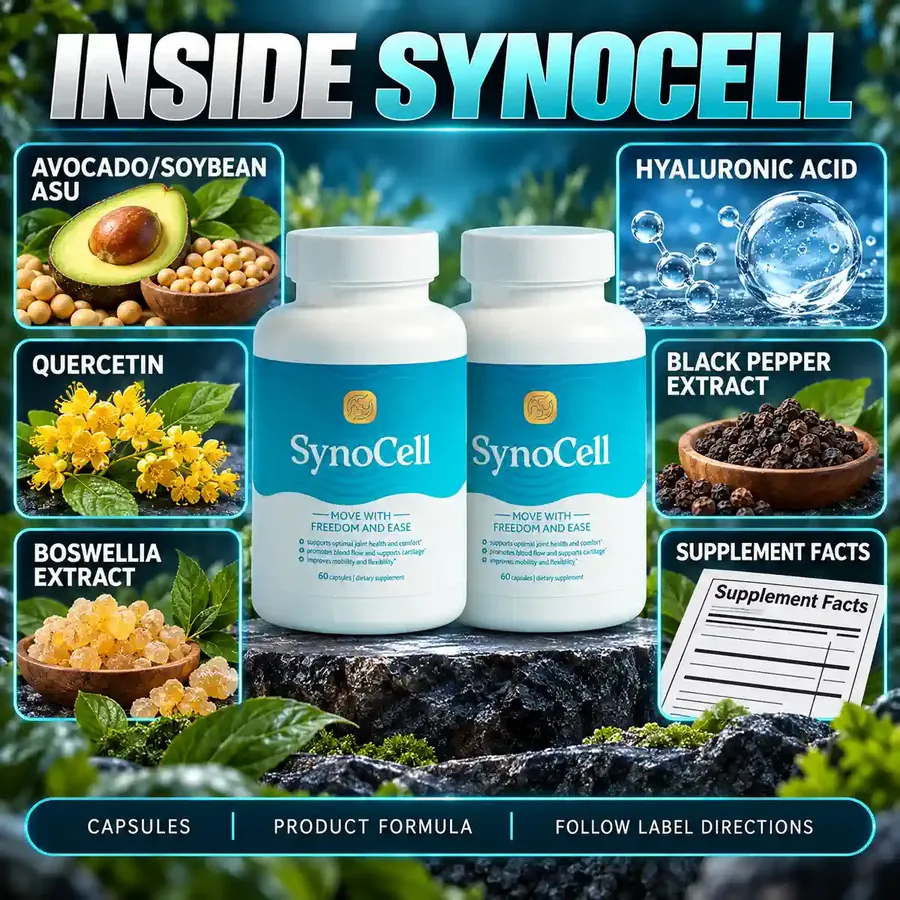
SynoCell lists it second, at 310 mg per serving. That ties it with ASU for the largest amount in the formula. The brand's "Inside SynoCell" graphic shows it as a cluster of yellow flowers.
Supplement makers often add quercetin for its effects in lab studies. The brand's product page does not say why it chose quercetin or which source it uses.
| Label name | Quercetin |
|---|---|
| What it is | Plant flavonoid · Plant pigment (flavonoid) |
| Position on the label | Printed with its own amount |
| Amount per serving (2 capsules) | 310 mg, printed |
| Amount used in research | No verified joint research dose |
| Strength of evidence | Not shown to treat any disease |
| Why it is used | Plant compound studied in the lab for inflammation |
| Main caution | May affect drug-processing enzymes; a case report showed warfarin's effect rising; not with losartan. |
Dose check
Is 310 mg of quercetin a studied dose for joints?
We could not verify one. None of our medical sources gives a quercetin dose for joint comfort or osteoarthritis. So 310 mg cannot be judged high or low for that purpose.
| Ingredient | SynoCell per serving | Research dose for comparison |
|---|---|---|
| Quercetin | 310 mg | No verified joint dose |
| ASU | 310 mg | 300 mg a day |
| Boswellia extract | 200 mg | Up to 1,000 mg a day |
| Black pepper extract | 5 mg | 5 mg in absorption studies |
| Hyaluronic acid | 180 mg | Oral dose not verified |
A large printed amount can look impressive. Without a trial to compare it with, the number only tells you how much is there, not what it does.
At a glance
Quercetin in SynoCell by the numbers
Evidence
What does research say about quercetin?
Very little that applies to joints in people. Memorial Sloan Kettering's About Herbs database states that "quercetin has not been shown to treat cancer or other diseases" (MSKCC Quercetin).
Lab results are not human results
Claims about quercetin and inflammation rest mainly on lab data, MSKCC notes (MSKCC Quercetin). Cells in a dish and animals often react differently from people. Many compounds that look good in the lab never show a benefit in human trials.
Not in the joint guidelines
The 2019 ACR/Arthritis Foundation osteoarthritis guideline does not mention quercetin at all (ACR/AF 2019 guideline). Nor do the NCCIH and Arthritis Foundation supplement pages we checked. It simply has not been studied enough for experts to weigh in.
We also found no reliable data on quercetin and the kidneys, in either direction. We make no kidney claims.
Formula logic
Why would SynoCell pair quercetin with black pepper extract?
Probably for absorption, though the brand does not say so. SynoCell adds 5 mg of black pepper extract, which raised nutrient levels in human studies (BioPerine review).
That pairing cuts both ways. Piperine, the active part of black pepper, may also slow the liver enzymes that clear many medicines (BioPerine review). Quercetin blocked two of those enzymes, CYP3A4 and CYP2C19, in lab tests (MSKCC Quercetin). Whether the two together matter in people is not known.
- No study has tested quercetin plus piperine at SynoCell's amounts.
- No study has tested quercetin alongside ASU, boswellia and hyaluronic acid.
- The brand's web pages give no reason for the pairing.
Safety
Can quercetin interact with blood thinners or blood pressure pills?
Yes, it may. MSKCC describes a case report of a raised INR, a blood clotting test, in a person on warfarin. It also reports that quercetin raised losartan levels in mice, and it advises against taking the two together (MSKCC Quercetin).
Ask your doctor or pharmacist before starting SynoCell. Bring the bottle so they can see the quercetin, boswellia and black pepper amounts together.
MSKCC also advises against quercetin with drugs cleared by CYP3A4 or CYP2C19 (MSKCC Quercetin). These include many common prescriptions, which is why a pharmacist check is quicker than guessing. Before any surgery, tell your surgeon about every supplement you take (NCCIH supplements wisely).
Quick check
Should you ask a doctor before taking quercetin in SynoCell?
Answer five quick questions. Any flagged answer means a short talk with your doctor or pharmacist first.
Our view
Is the quercetin in SynoCell worth it?
It is the weakest-supported large ingredient in the formula. It is printed clearly, which lets you and your pharmacist judge it, but it adds medicine cautions without proven joint benefit.
Pros
- Amount printed: 310 mg
- A common food compound
- Paired with an absorption helper
Cons
- Not shown to treat any disease
- No verified joint dose or trial
- Warfarin, losartan and enzyme cautions
Compare it with ASU, which has the strongest support of the five, or read the side effects guide.
FAQ
Quercetin in SynoCell: common questions
How much quercetin is in SynoCell?
SynoCell lists 310 mg of quercetin per 2-capsule serving, according to the brand's product page. That is about 31% of the 1,005 mg serving and ties with ASU for the largest amount. Check the Supplement Facts on the bottle you receive to confirm it.
Does quercetin help joint pain?
There is no verified evidence that quercetin helps joint pain in people. Memorial Sloan Kettering says quercetin has not been shown to treat any disease, and its inflammation claims rest mainly on lab data (MSKCC Quercetin). The ACR joint guideline does not mention it (ACR/AF 2019 guideline).
Can I take quercetin with warfarin?
Ask your doctor before taking quercetin with warfarin. Memorial Sloan Kettering reports a case of a raised INR, a clotting test, in someone on warfarin who took quercetin (MSKCC Quercetin). Your doctor may want to check your INR more often if you start SynoCell.
Is quercetin safe with losartan?
Memorial Sloan Kettering advises against taking quercetin with losartan (MSKCC Quercetin). In mice, quercetin raised losartan levels in the blood. If you take losartan for blood pressure, talk to your doctor or pharmacist before starting SynoCell, which contains 310 mg of quercetin per serving.
Is quercetin bad for your kidneys?
Our sources give no reliable data on quercetin and the kidneys, in either direction. Memorial Sloan Kettering's quercetin page has no kidney findings (MSKCC Quercetin). If you have kidney disease, ask your doctor before taking any supplement, including SynoCell.
What foods contain quercetin?
Quercetin is a plant pigment found in small amounts in foods such as onions, apples, berries and tea. A diet rich in fruits and vegetables supplies some daily. SynoCell's 310 mg is a concentrated supplement dose, which is why medicine cautions apply to it.
Who wrote this
Written and reviewed by
Plain-language pages built from the bottle label, the order page and linked public health sources such as NIH, FDA and CDC.
Last updated . See our editorial standards and how we check reviews. This website is run by a U.S. retail desk for SynoCell, not by the manufacturer. This site earns money when you buy through our order links.
Keep reading
More about SynoCell
Black pepper extract (BioPerine)
SynoCell has 5 mg of BioPerine. How black pepper extract boosts absorption, and why that matters for your medicines.
Read more
Side effects
SynoCell side effects ingredient by ingredient, the medicine interactions that matter most, and when to stop.
Read moreASU (avocado/soybean)
SynoCell's ASU dose sits right at the 300 mg studied. What four trials found, and what they cannot tell you.
Read moreLicensed U.S. retail desk for SynoCell
Ready to try SynoCell?
Pick a pack. Two capsules a day; the 3- and 6-bottle packs cover the whole 90-day window.
- Secure brand checkout
- 90-day money-back window
- Free U.S. mainland shipping