Evidence check
SynoCell: Does It Work? Joint Pain Research Explained
SynoCell’s lead ingredient, ASU, is dosed close to the 300 mg a day used in trials, which found small benefits mainly for the knee. The other four ingredients have lighter joint research. A steady, fair test of 2 capsules a day is the best way to judge it.
Written by the SynoCell editorial teamUpdated · 8 min read
Medically reviewed by Dr. Priya Reddy, MD, FACR, Physician · Review date:
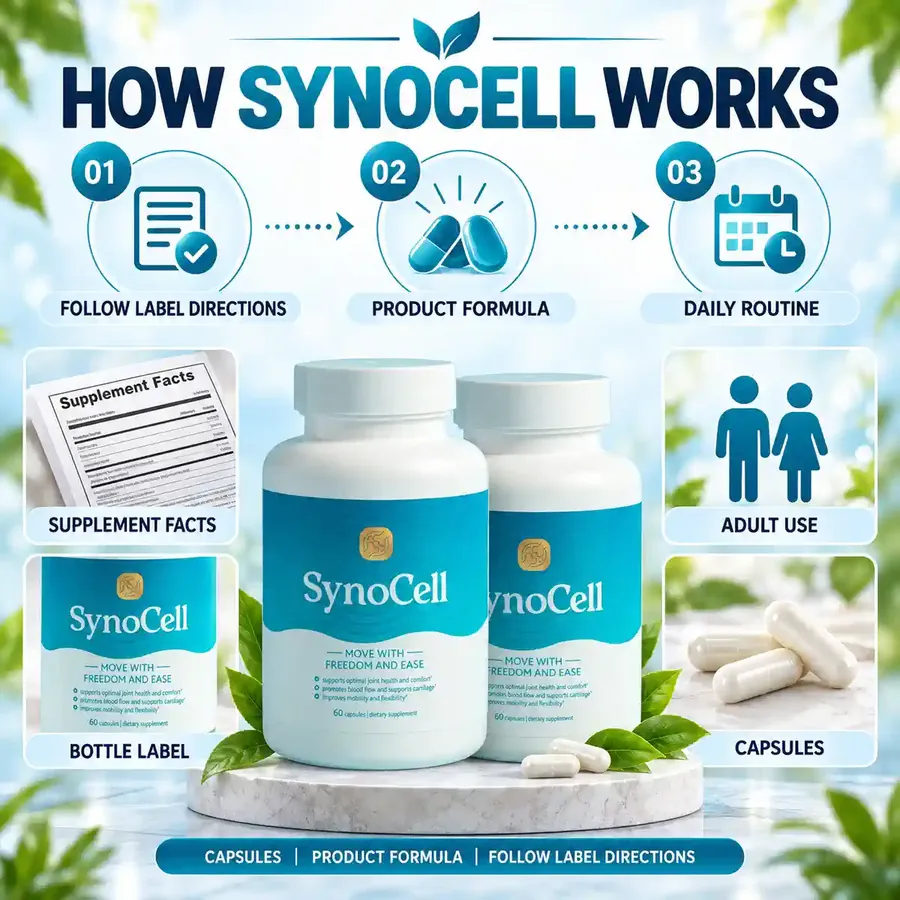
- SynoCell is sold for joint comfort and mobility. It is a supplement, not a drug and not a treatment for arthritis.
- Five lines per 2 capsules, led by ASU and quercetin at 310 mg each and ending with black pepper extract at 5 mg.
- ASU trials used 300 mg a day for 3 to 12 months and found small benefits, mainly for the knee.
- Quercetin and oral hyaluronic acid have no verified joint evidence in the sources this site uses.
- No published trial tested SynoCell itself, so the formula has no proven result.
- The brand's money-back window runs 90 days from the purchase date, once you have used it as directed for 30 days.
Try SynoCell with the 90-day window in viewIf you decide to test it yourself, the order page shows the current price and the full wording of the 90-day refund terms.
See today's price and guaranteeThis site earns money when you buy through its order links. The button opens the brand's own order page.
The basics
What does SynoCell do, and what is it for?
SynoCell is sold to support everyday joint comfort and mobility. That is all the brand may say, and it is all this page will say about its purpose.
The bottle front carries the line "Move with freedom and ease." Brand graphics add three small claims about joint comfort, blood flow and flexibility. Those are marketing lines. FDA does not check them before sale (FDA S/F claims).
The product is a capsule, 60 to a bottle, and the brand's serving is 2 a day. As a dietary supplement it is not a medicine, and it is not intended to diagnose, treat, cure or prevent any disease.
So when people ask what SynoCell is good for or what it is used for, the honest answer is narrow. Adults buy it hoping for a little more ease in stiff joints. Whether they get it is the real question.
The formula
How does SynoCell work, ingredient by ingredient?
SynoCell does not work as one proven unit. It is a mix of five ingredients, and each has its own research story. The table shows the amount in a serving next to what studies looked at.
| Ingredient | Amount | What research shows |
|---|---|---|
| Avocado/soybean unsaponifiables (ASU) | 310 mg | Small to moderate gains in pain and function, mainly the knee, at 300 mg a day |
| Quercetin | 310 mg | No verified joint dose. Not shown to treat any disease |
| Boswellia extract (std. to 65% boswellic acid) | 200 mg | May ease osteoarthritis pain. Studies are low quality |
| Hyaluronic acid | 180 mg | Uncertain for capsules. Guidelines cover injections only |
| Black pepper extract (BioPerine) | 5 mg | Raised absorption of some nutrients in people. Not a joint ingredient |
The black pepper extract is there to help the body take up the others. That is a reasonable idea, but no study in the sources used here tested it with these four ingredients (BioPerine review). It may also raise blood levels of some medicines, which is a safety point and not a benefit.
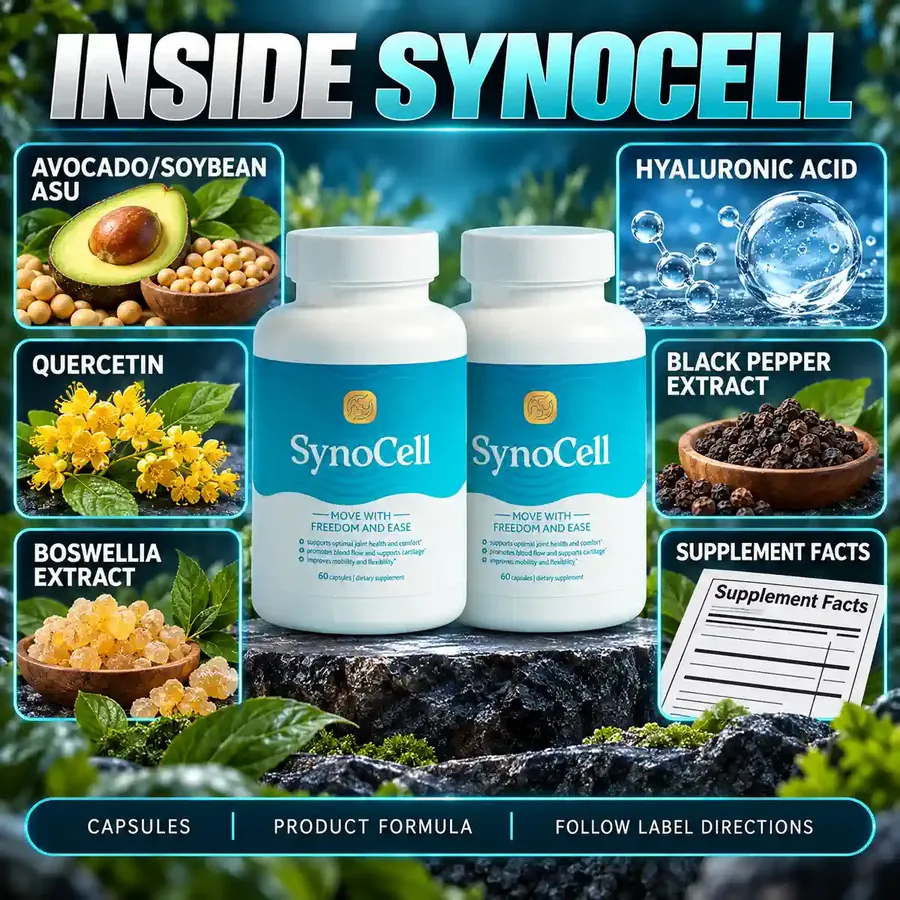
A brand graphic shows how the pieces are supposed to fit. It is a picture. It carries no amounts and no results.
The research
Does research show SynoCell works for joint pain?
Research exists for some of the parts. It does not exist for the whole.
ASU: the best case
The key paper is a 2008 analysis of four trials, 664 people in all, who took 300 mg of ASU a day for 3 to 12 months. Pain and daily function improved slightly more than on a dummy pill, mostly in the knee. The hip result was not significant (ASU meta-analysis (DARE)). About 6 people had to take ASU for one extra person to improve.
There are caveats. The trials were small, the results varied and industry paid for all four. They also used one specific ASU product, and SynoCell does not publish where its ASU comes from. The Arthritis Foundation calls the evidence weak and the gains modest (AF 12 supplements).
Boswellia: promising but thin
NCCIH says several studies suggest boswellia taken by mouth may reduce osteoarthritis pain, and that larger, better studies are needed (NCCIH Boswellia). Trials used up to 1,000 mg a day. SynoCell has 200 mg, so it sits at the low end.
Quercetin and hyaluronic acid: little to go on
For quercetin, Memorial Sloan Kettering finds no sign that it treats any disease (MSKCC Quercetin). For hyaluronic acid, the joint guideline speaks only about injections (ACR/AF 2019 guideline). Injection results do not carry over to capsules.
For ASU and boswellia, NCCIH describes slight improvements that patients may not find meaningful (NCCIH OA). That is the fair size of the claim.
Put it in order
How well does SynoCell work compared with exercise and weight loss?
Not as well as the basics, and it is not meant to. The 2019 guideline from the American College of Rheumatology and the Arthritis Foundation strongly recommends exercise, weight loss, self-management, tai chi, and canes or braces (AF guideline summary). ASU, boswellia, quercetin and oral hyaluronic acid are not rated by that guideline at all.
Weight matters more than most people expect. Shedding a pound reduces the load on the knee 3 to 6 fold (StatPearls OA). Over 10 years, losing 10 pounds can lower the chance of knee osteoarthritis by up to 50% (ACR OA patient).
A supplement can sit on top of that base. It cannot stand in for it. If you do not move more and you do not manage your weight, a capsule is unlikely to be the thing that changes your day.
Who benefits
Who is most likely to notice anything from SynoCell?
The best match to the research is an adult with mild knee stiffness who also stays active. The ASU trials enrolled adults with knee or hip osteoarthritis, and the knee results were clearer (ASU meta-analysis (DARE)).
Results vary. Some people notice nothing, and that is common with joint supplements. Joint pain also rises and falls on its own. Weather, a long drive or a new pair of shoes can change how a knee feels, so a good week proves little.
Skip the supplement question and see a doctor if a joint is hot, red or very swollen, if you have a fever, if a joint locks or gives way, or if pain wakes you at night. Those signs are not a reason to wait for a capsule to work.
Try it properly
How can you test whether SynoCell works for you?
A fair test is simple. It needs time, a few numbers and no other big changes.
- Before day one, score your knee or hip pain from 0 to 10, note how many minutes morning stiffness lasts, and count the stairs you climb before you stop.
- Take the listed serving of 2 capsules daily, plus any extra directions printed on the bottle.
- Keep your exercise steady. If you start a new walking plan or lose weight during the test, any gain may come from that.
- Repeat your scores on day 30, day 60 and about day 85.
- Decide before day 90. The refund window shuts 90 days after purchase, and 30 days of use must come first.
The results timeline page has a printable tracking table. Ask your doctor or pharmacist before you start if you take blood thinners, losartan or other prescription medicines.
FAQ
Frequently asked questions
Does SynoCell really work for joint pain?
It may give a small benefit for knee comfort, based on trials of ASU at 300 mg a day. No trial has tested SynoCell itself. Many people notice little change, and it is not a treatment for arthritis or any disease.
What is SynoCell good for?
The brand markets it for joint comfort and mobility. The ingredient with the best research, ASU, showed small gains in knee pain and function in trials. That is a narrow and modest claim, not a cure or a fix for joint damage.
Is SynoCell effective?
Its effect as a formula is unproven because no trial of SynoCell exists. ASU is dosed near the studied amount. Quercetin and oral hyaluronic acid have no verified joint evidence. Judge it yourself over a fair test and keep exercising.
Does SynoCell actually relieve pain?
The brand does not promise pain relief, and its refund policy covers money, not results. Some people may feel slightly better, and others may feel nothing. Track your own scores so you do not rely on memory or mood.
How does SynoCell work in the body?
The brand does not describe a mechanism, and none has been proven for the full formula. Each ingredient has its own research. The black pepper extract is meant to help absorption, and it may also raise levels of some medicines.
Can SynoCell replace my pain medicine?
No. Keep taking what your doctor prescribed and talk to your doctor before changing any medicine. SynoCell is a dietary supplement. It is not FDA approved. Like any supplement, it is not intended to diagnose, treat, cure or prevent a disease.
What does SynoCell do for joint pain?
SynoCell is a dietary supplement sold for joint comfort and mobility. Ingredient studies, mainly on ASU, point to small gains in comfort and function, but the product itself has no published trial.
Does SynoCell work better than exercise?
No. Guidelines put exercise and weight loss first, and a supplement is at most an add-on. SynoCell cannot replace them, so keep moving and see the capsules as a small extra.
What dose of ASU is used in joint trials?
Trials of ASU used about 300 mg a day. SynoCell lists 310 mg per 2 capsules, and a fair test is 2 capsules a day.
Our honest take
Our view
Our view is that SynoCell is a modest bet with an honest label. The ASU dose is close to what trials used, and the amounts are printed, which is more than many joint products offer. Those are real points in its favor.
The same facts cap the claim. The trials behind ASU found small gains, mainly in the knee, and the other four ingredients add little proven joint benefit. No one has tested the mix. A fair summary is that SynoCell might help a little, for some people, next to exercise.
If you want to try it, treat it as a 90-day experiment. Write your scores down, keep moving, and use the refund window if nothing changes. Never use it instead of care for a hot, swollen or injured joint.
Related reading on this site: benefits explained, the how it works page and does SynoCell work for knee pain.
Still curious? Read the label firstA fair test needs time, notes and steady exercise. The order page shows the price and the refund wording before you commit.
See today's price and guaranteeThis site earns money when you buy through its order links. The button opens the brand's own order page.
Last updated . Written by the SynoCell editorial team and medically reviewed by Dr. Priya Reddy, MD, FACR, Physician (review date October 16, 2026). This page is general information, not medical advice. SynoCell is a dietary supplement. It is not FDA approved, and no supplement is. Ask your doctor or pharmacist about your own case.