Ingredient deep dive
Oral Hyaluronic Acid vs Injections: SynoCell Capsules
Oral hyaluronic acid in SynoCell capsules is not the same as a joint injection. SynoCell lists 180 mg per 2 capsules. The 2019 ACR/Arthritis Foundation guideline speaks about injections in the hip and knee, and it does not cover capsules taken by mouth.
Written by the SynoCell editorial teamUpdated · 8 min read
On the label
How much hyaluronic acid is in SynoCell?
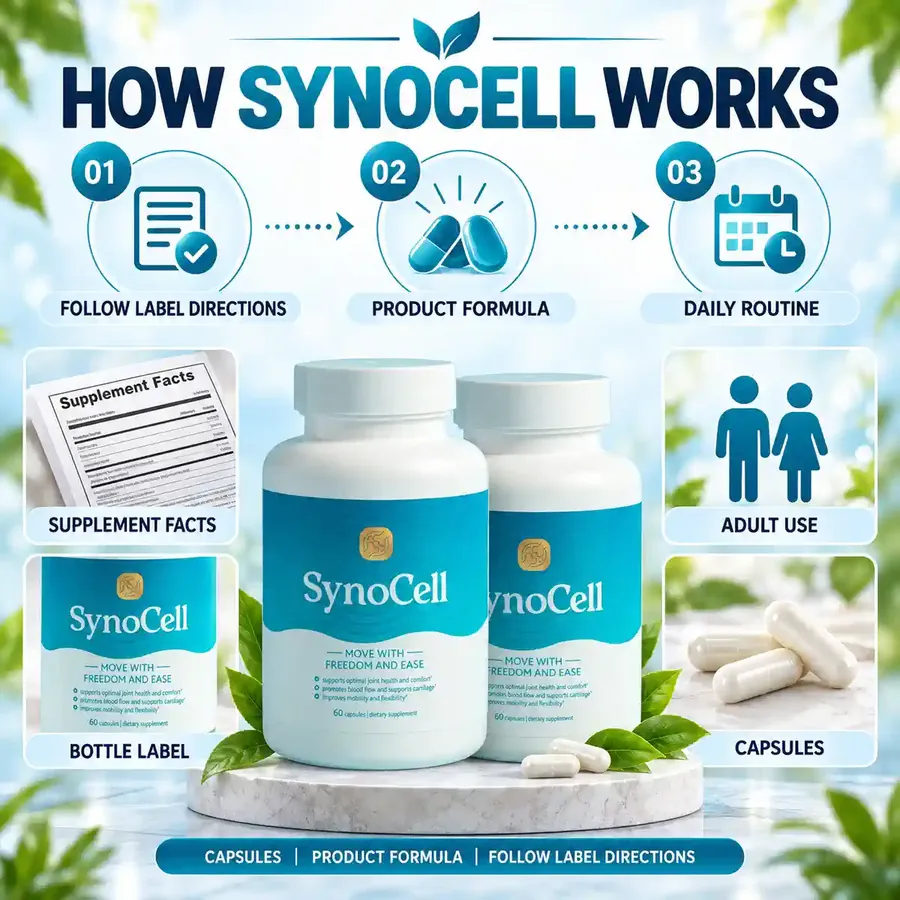
SynoCell has 180 mg of hyaluronic acid per serving of 2 capsules, as published by the brand. It is the fourth of five ingredients on the brand's product page.
The amount is printed on its own line. It is not hidden inside a proprietary blend. That makes it easy to see exactly what you swallow each day.
The label lists "Daily Value (DV) not established" for it. That is normal: hyaluronic acid is not a vitamin or mineral, so the FDA has no daily target for it, and the panel shows a symbol instead of a percentage (FDA Labeling Ch IV).
The brand's product page does not say which form of hyaluronic acid it uses or what size the molecules are. Those details can matter for how a swallowed molecule behaves. You can see the full panel on the SynoCell Supplement Facts page and compare it with the bottle you receive.
The basics
What is hyaluronic acid?
Hyaluronic acid is a large sugar-based molecule your body makes on its own. It is found in skin, eyes and the fluid inside joints.
In a healthy joint, that fluid is thick and slippery. In osteoarthritis, the cartilage that covers the ends of the bones slowly breaks down, which leads to pain, stiffness and swelling (MedlinePlus OA).
Because the molecule is part of normal joint fluid, it is easy to assume that adding more will help the joint. That idea sounds simple. The research picture is not, and the way the molecule gets into your body changes everything.
There are two very different ways to take it:
- Injection. A doctor puts a gel straight into the knee or hip joint, often called viscosupplementation.
- Capsule. You swallow it. It passes through the stomach and gut first, like any food or pill.
The guideline
What does the 2019 guideline say about hyaluronic acid injections?
The 2019 American College of Rheumatology and Arthritis Foundation guideline recommends against hyaluronic acid injections in the hip. It conditionally recommends against them in the knee and at the base of the thumb (ACR/AF 2019 guideline).
"Conditionally" means the panel was less certain. A doctor and patient may still choose an injection in some cases. But the default advice leans against it.
| Form and joint | Guideline position | Applies to SynoCell? |
|---|---|---|
| Injection, hip | Strongly against | No, SynoCell is a capsule |
| Injection, knee | Conditionally against | No, SynoCell is a capsule |
| Injection, base of thumb | Conditionally against | No, SynoCell is a capsule |
| Oral (capsules) | Not addressed | The guideline is silent |
The guideline also leaves out ASU, boswellia and quercetin, the other main ingredients in SynoCell (ACR/AF 2019 guideline). Silence is not approval and it is not rejection. It simply means the panel did not rate them.
Different routes
Why don't injection results apply to SynoCell capsules?
An injection and a capsule deliver the molecule in different ways, at different doses, to different places. A result from one says nothing reliable about the other.
Where it goes
An injection places the gel directly inside one joint. A capsule goes to the gut, and only part of what you swallow, if any, may reach the bloodstream intact.
How much arrives
Injected doses go straight to the joint space. With a swallowed dose, the share that reaches a knee or hip is not known from our sources.
What was tested
The guideline judged injection studies. No capsule trial was rated, so there is nothing to borrow for 180 mg by mouth.
The FTC makes the same point for marketing. Health claims need research that matches the product's dose, form and ingredients (FTC health products). A study of a joint injection does not support a claim about a capsule. Neither does a study of a different capsule at a different dose.
Honest gap
Is there good evidence for oral hyaluronic acid?
We could not verify it. None of the sources we opened and checked for this site rates hyaluronic acid taken by mouth for joint comfort, so we treat the evidence as uncertain.
That is not the same as saying it has been shown not to work. It means we have no trustworthy, checked source to point you to. We would rather say that plainly than borrow results from injections or from a different product.
We will say SynoCell contains 180 mg of hyaluronic acid, and that its role in a capsule is unproven in our sources. We will not say it rebuilds or protects cartilage, or that it acts like the fluid in your joint. Disease claims are not allowed for supplements in the first place (FDA S/F claims).
The National Center for Complementary and Integrative Health notes that little safety information exists for most herbal and supplement products used for osteoarthritis (NCCIH OA). That general caution applies here too.
Our hyaluronic acid ingredient page keeps this rating up to date if checked sources change.
Read with care
What should you make of joint claims about hyaluronic acid pills?
Treat strong claims with care. Ads for joint pills often describe hyaluronic acid as if it goes straight into the knee. A capsule does not work like a syringe.
Watch for these signs when you read any hyaluronic acid product page:
- Claims that a pill restores the joint or brings back lost cartilage.
- Injection studies quoted as if they were tested on capsules.
- Results promised by a fixed date, or "guaranteed".
- Personal stories used in place of research.
The FDA lists quick fixes and testimonials among common health-fraud warning signs (FDA 6 tip-offs). The brand's own marketing for SynoCell goes further than its own disclaimer allows, and we do not repeat its claims about cartilage. The bottle carries the standard FDA statement: These statements have not been evaluated by the Food and Drug Administration. This product is not intended to diagnose, treat, cure, or prevent any disease.
The whole formula
Where does hyaluronic acid fit in the SynoCell formula?
Hyaluronic acid is 180 mg of the 1,005 mg in each serving. The ingredient with the clearest research is ASU at 310 mg, close to the 300 mg a day used in trials that found small benefits, mainly for the knee (ASU meta-analysis (DARE)).
So if SynoCell helps you at all, the evidence points more to ASU and possibly boswellia than to hyaluronic acid. That is a fair way to set your expectations.
Guidelines still put exercise, weight management and self-management ahead of any supplement (AF guideline summary).
Your options
Should you ask your doctor about injections or capsules?
Yes, if knee or hip pain is limiting your day. A doctor can weigh injections, other treatments and supplements against your own history. Bring this list to the visit:
Your symptoms
Which joints hurt, when stiffness is worst, and how far you can walk.
Your products
Every medicine and supplement, including SynoCell and its five ingredients.
Your goal
Stairs, gardening or walking the dog. A clear goal helps you judge any option.
A hot, red or very swollen joint, fever, a sudden injury, a joint that locks or gives way, or pain that wakes you at night needs a medical check, not a supplement.
FAQ
Oral hyaluronic acid questions
Does oral hyaluronic acid work for joints?
The evidence is uncertain, and none of the sources we checked rates it. The 2019 ACR/Arthritis Foundation guideline covers only hyaluronic acid injections, not capsules (ACR/AF 2019 guideline). SynoCell's 180 mg should be seen as an ingredient with an open question, not a proven one.
Is SynoCell the same as a hyaluronic acid injection?
No. SynoCell is a capsule you swallow, with 180 mg of hyaluronic acid per 2 capsules. An injection puts a gel straight into one joint. The two differ in route, dose and what has been tested, so injection results do not transfer.
Does the ACR recommend hyaluronic acid injections?
No. The 2019 ACR/Arthritis Foundation guideline recommends against injections in the hip and conditionally against them in the knee and base of the thumb (ACR/AF 2019 guideline). A doctor may still discuss them in some cases.
Is 180 mg of hyaluronic acid a lot?
We cannot say, because no verified oral dose for joints exists in our sources. 180 mg is the amount the brand prints per 2 capsules. Without a checked study dose, there is nothing reliable to compare it with.
Do hyaluronic acid capsules help cartilage?
There is no evidence in our sources that they do, and SynoCell is not a treatment for cartilage damage or osteoarthritis. Supplements may not make disease claims (FDA S/F claims). Exercise and weight management are the first steps guidelines recommend.
Is hyaluronic acid in SynoCell safe with my medicines?
Hyaluronic acid itself has no interaction flagged in our sources. Other SynoCell ingredients do: quercetin, boswellia and black pepper extract can affect some medicines. Show the full label to your pharmacist before you start.
Do SynoCell hyaluronic acid pills work like injections?
No. The guideline material covers injections into the joint, and those findings do not carry over to capsules. Evidence for swallowed hyaluronic acid is uncertain and was not verified in our sources.
How much hyaluronic acid is in SynoCell?
SynoCell lists 180 mg of hyaluronic acid per 2-capsule serving. It is one of five printed amounts, alongside ASU 310 mg, quercetin 310 mg, boswellia 200 mg and black pepper extract 5 mg.
Does the 2019 ACR guideline cover hyaluronic acid capsules?
No. The guideline speaks about hyaluronic acid injections in the hip and knee, so its findings do not carry over to capsules.
Who wrote this
Written and reviewed by
Plain-language pages built from the bottle label, the order page and linked public health sources such as NIH, FDA and CDC.
Last updated . See our editorial standards and how we check reviews. This website is run by a U.S. retail desk for SynoCell, not by the manufacturer. This site earns money when you buy through our order links.
Keep reading
More about SynoCell

Hyaluronic acid
SynoCell has 180 mg of hyaluronic acid in capsules. Why injection research does not carry over, and what stays unknown.
Read more
Supplement Facts
The SynoCell Supplement Facts explained line by line, plus the label details the brand's web pages leave out.
Read more
Osteoarthritis guide
What osteoarthritis is, who gets it, what doctors recommend first and where a joint supplement fits.
Read moreLicensed U.S. retail desk for SynoCell
Ready to try SynoCell?
Pick a pack. Two capsules a day; the 3- and 6-bottle packs cover the whole 90-day window.
- Secure brand checkout
- 90-day money-back window
- Free U.S. mainland shipping